




Why Formulation Philosophy Matters for Quality
When it comes to health products, most people focus on ingredient quality. It’s a valid point, given that high-quality ingredients can have significant effects on health. However, there's another critical aspect that often goes unnoticed: formulation philosophy. Understanding why formulation philosophy matters as much as ingredient quality can help you make informed choices about the wellness products you consume.
The interplay between ingredients and formulation
Ingredient quality refers to the sourcing and processing of each component in a product. Formulation philosophy, on the other hand, involves how these ingredients are combined and the intended effects of that combination. A well-formulated product can enhance the benefits of high-quality ingredients, while a poorly designed formula can diminish their effectiveness.
For example, consider the role of synergy. Certain ingredients work better together than they do alone, a principle known as synergistic effect. Turmeric and black pepper are a classic example; the piperine in black pepper enhances the absorption of curcumin from turmeric. Thus, a product that combines these two ingredients thoughtfully can offer more benefits than one that simply lists them separately.
Why formulation philosophy is critical
Formulation philosophy is critical for several reasons:
- Bioavailability: This refers to the degree and rate at which an active ingredient or active moiety is absorbed and becomes available at the site of action. A well-thought-out formulation can enhance bioavailability, ensuring that the body can utilize the active compounds effectively.
- Stability: Some ingredients are sensitive to light, heat, or oxygen. A good formulation takes these factors into account, ensuring that the product remains stable and effective throughout its shelf life. For instance, cold-pressed juices are often more stable and retain more nutrients than their heat-processed counterparts.
- Flavor and palatability: Even the best ingredients won't be effective if they're unpleasant to consume. Formulation philosophy includes considering taste and mouthfeel, which can influence adherence to a health regimen.
Real-world examples of formulation philosophy
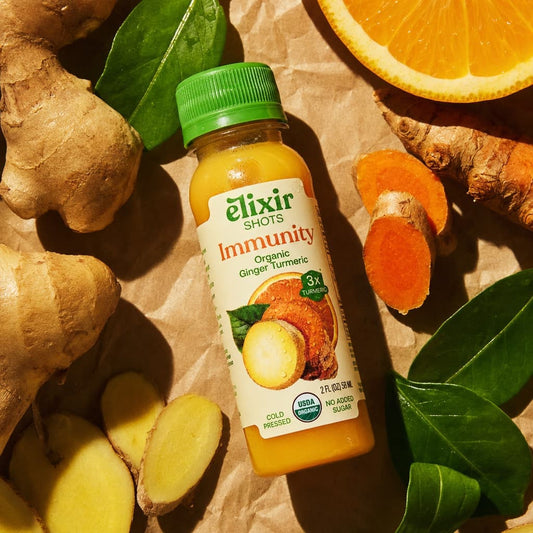
Take a look at Elixir Shots. Each shot is crafted with a specific formulation philosophy that complements the high-quality ingredients used. For instance, the Immunity shot combines cold-pressed orange juice, ginger, and turmeric to create a product that not only tastes good but also maximizes the health benefits associated with these ingredients.

Research indicates that the combination of ginger and turmeric may support anti-inflammatory responses in the body. This is a prime example of how thoughtful formulation can lead to enhanced effects.
How to assess formulation philosophy
When evaluating wellness products, consider the following:
- Ingredient synergy: Look for products that combine ingredients known to work well together.
- Processing methods: Research how the ingredients were processed. Cold-pressed methods, for instance, generally preserve more nutrients compared to heat processing.
- Transparency: Brands that clearly explain their formulation philosophy and ingredient sourcing are often more trustworthy.
Understanding these factors can empower you to choose products that align with your health goals.
Conclusion
In summary, while ingredient quality is crucial, formulation philosophy plays an equally important role in determining the effectiveness of health products. By considering both aspects, you can make more informed decisions about the wellness shots you incorporate into your daily routine. The next time you reach for a wellness product, take a moment to reflect on its formulation philosophy and how it complements the quality of its ingredients.
Sources
- Curcumin and Ginger: A Review of Their Therapeutic Potential. Journal of Medicinal Food. 2018. https://pubmed.ncbi.nlm.nih.gov/29318129
- Bioavailability of Curcumin: A Review. Journal of Clinical Pharmacology. 2017. https://pubmed.ncbi.nlm.nih.gov/28665418
- Enhancing the Stability of Nutraceuticals: A Review. Food Research International. 2019. https://pubmed.ncbi.nlm.nih.gov/30861066